
Build a Hillsdale County Former-Owner Timeline
The best ownership history leans on recorded conveyances. Other records fill gaps and explain them. Hillsdale County deed records are locally described from 1835, though the Register posts no exact start year for its online index or images.
| Source | Years It Covers | Where Held | What It Shows |
|---|---|---|---|
| Cloud and legacy deed indexes | Modern indexed material; cutoff unposted | Register of Deeds | Parties, dates, type, and recording reference |
| Tract and deed books | Older and property-oriented searches | Register/Kofile | Earlier conveyances by land description |
| Probate and court files | Estate and litigated transfers | Probate or Circuit Court/Archives | Authority, heirs, orders, and context |
| Historic tax rolls | Selected archival years | Archives of Michigan | Names linked to taxed land between deeds |
Recorded deeds come first. Tax rolls, probate files, directories, census entries, and newspapers all help, but treat them as dated supporting layers rather than automatic substitutes for a conveyance.
Begin with the Current Hillsdale Grantee
Open FetchGIS and find the parcel. Note the PIN, legal description, and owner name. Also note any last recorded deed or plat reference it shows. Then move to the Register's official index. The newest conveyance should match the land as well as the name. Keep the mailing address separate from the situs address. A mailing address is only an identity clue, never the property's location. Trusts, estates, LLCs, and fiduciaries demand exact spelling. A transfer can pass through an entity name that looks nothing like the occupant's.
Walk Hillsdale's Deed Chain Backward
Work in reverse order, newest deed first. Each deed names the prior owner and repeats a land description that should agree with the next deed back. Build a table as you go.
- Record the current grantee, grantor, recording date, document number or liber/page, and exact legal description.
- Search the grantor as an earlier grantee, narrowing by date, subdivision, and instrument type.
- Confirm that the earlier deed covers the same lot, block, section, or metes-and-bounds land.
- Repeat until online results stop, then take the last citation into tract books, deed books, or archival holdings.
- Grantor / grantee
- The conveying and receiving parties named by an instrument.
- Chain of title
- The chronological sequence of conveyances affecting the land.
- Legal description
- The lot, plat, section, or surveyed words that identify the property across address changes.
Branches in the trail call for caution. Note exactly what interest each deed conveys. A quitclaim may pass only one person's stake, an estate deed may rest on probate authority, and a release can clear an encumbrance without moving ownership at all.
Separate the 1835 Claim from Online Coverage
Local sources describe county deed records dating from 1835. That claim covers the historical collection. It does not promise complete coverage. Not every deed, index entry, or image since 1835 is searchable online. The cloud portal's earliest year and image cutover stay unposted. Use the cloud Quick Search for indexed text or OCR. The legacy name, date, and liber-page system handles older references. Kofile tract-book links serve land-oriented work. A web failure is not always a records gap. Ask the Register whether a particular volume is imaged. The Register's official search page lays out the term, date-range, and index/OCR choices. Those choices begin a backward chain.
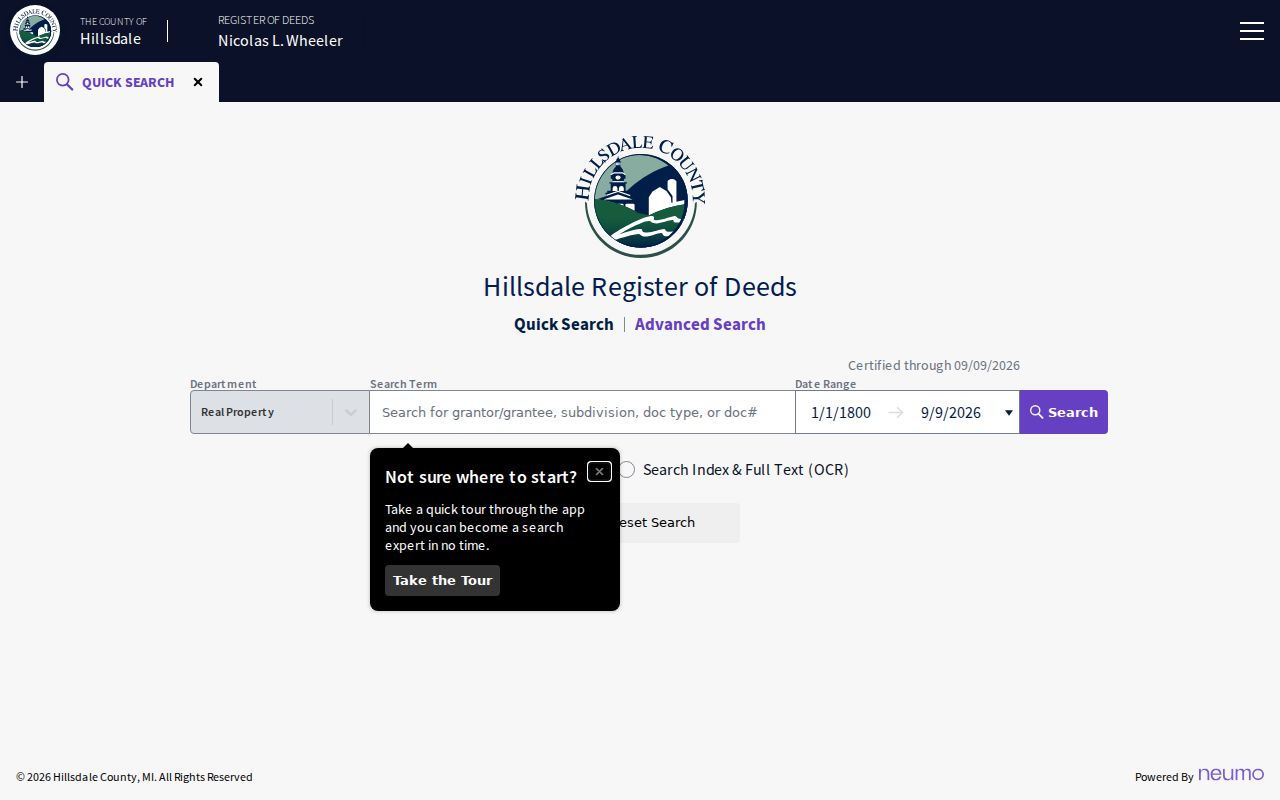
Copy the exact indexed spelling from each result. It may differ from the spelling later assessment records use, and that variance matters when you step back to the preceding owner.
Insider method. Carry a verified liber/page or document number from one system to the next. A precise citation gives staff a far better retrieval request than an owner name with no dates.
Reconstruct Former Owners after the 1847 Fire
Hillsdale County's first courthouse burned on December 28, 1847. County operations moved into the replacement courthouse in January 1848. Which deed volumes survived is not documented. Treat the fire as a search complication. It is no reason to declare all pre-fire land evidence lost.
Historic tax rolls show who was associated with taxed land in a given year. Probate papers explain succession. Court files can preserve disputes and orders. Census schedules, land records, plats, newspapers, and family papers add dated connections; label each source for what it proves, whether residence, assessment, inheritance, litigation, or conveyance.
Archives of Michigan keeps a Hillsdale County guide. It identifies tax, probate, court, naturalization, census, and land holdings, and a useful request includes names, approximate dates, township or city, plat or section, and the last known deed citation.
Bridge Hillsdale Estate Transfers with Probate
A chain can stop at a death. A later deed may be signed by a personal representative, trustee, heir, or estate, so search the probate file for the decedent, authority to act, inventory, orders, and distributions. Then return to the recorded deed. Note the land actually conveyed. The Archives guide lists Hillsdale probate records under archival group RG 2019-9. Current probate matters sit with the county Probate Court. Probate evidence explains why names changed, but the recorded legal description is the check that the estate matter concerns the subject parcel.
Use Hillsdale Tax Rolls Between Recorded Deeds
A tax roll earns its keep when surviving deeds leave a long interval. Compare names across consecutive available years. Preserve the township, city, description, acreage, and valuation fields. A shift in the assessed name can narrow the likely transfer window. It may also hint at an estate event. Assessment never proves fee ownership by itself. The roll can lag a deed, abbreviate a name, or point to a responsible taxpayer, so use it to generate dates and names for another deed-index search rather than to fill a title gap silently.
Keep Hillsdale Plat Names with Every Past Owner
Named plats can steady a search when addresses change. The county subdivision list includes Hillsdale-area names like Assessors Plat of City and Three Meadows. It also lists numerous lake and resort plats elsewhere. Record the plat exactly. Add lot, block, phase, and municipality. A modern postal city is not always the assessing municipality. At city or township edges, confirm the GIS Municipality field and the legal description before assigning a past owner to the wrong jurisdiction. The Hillsdale County parcel map guide explains PIN and plat context.
Mitchell Directories Add Occupants, Not Automatic Owners
The Mitchell Research Center holds local-history material that goes well beyond deed records. City directories, maps, newspapers, and cemetery and church records all appear in its collections. Directories let you follow a surname and an address across editions. Newspapers and obituaries can surface marriages, estates, moves, and property notices. A parcel number stays the same, but the people attached to it change.
One caution matters here. An occupant was not automatically the owner of record. Match directory years against census and tax roll evidence. Watch for street renumbering or spelling shifts. Confirm every link in the chain with the deed records themselves. A directory entry can narrow the dates for a former owner. It cannot prove a conveyance on its own.
Know Where a Hillsdale Ownership Chain Ends
A trustworthy ownership chain stops where the evidence stops. It ends at the earliest verified source, never at an assumed online cutoff. A nineteenth-century parcel may trace back to a surviving deed book, a tract-book entry, or a patent in the original land records. Archival tax and probate material can fill the years between. Federal and state land sources can precede county conveyances entirely. Even so, each must connect to the same legal land description. Only then does it belong in the chain of title.
When a stretch of evidence stays missing, say so plainly. Record the gap and the repositories you searched. Resist the urge to insert an unsupported name between prior owners. If the result will guide a purchase, an estate, or a boundary resolution, that matters. So bring in a professional title examiner or attorney. Hillsdale County property records answer many questions, but the hardest gaps deserve expert eyes.
Lawful use. Former-owner research supports house history, estate work, and property diligence. Do not use names or addresses from Hillsdale County records to track, threaten, or harass a living person.