
Which Hillsdale County Deed Record Fits the Transfer?
A deed is only one instrument the Register of Deeds records. Mortgages, liens, easements, plats, releases, and assignments all land in the same books. A deed shows a transfer. A lien or mortgage shows a claim against the land instead. Check the document type before you chase names. That way an encumbrance never gets mistaken for a change in ownership.
| Deed Type | What It Does | Common Use |
|---|---|---|
| Warranty deed | Conveys the stated interest with broad title covenants | Ordinary arm's-length conveyance |
| Quitclaim deed | Conveys whatever interest the grantor holds without broad warranties | Family transfers or title cleanup |
| Fiduciary deed | Transfers property through an estate, trust, or authorized representative | Probate and trust administration |
| Sheriff or court deed | Records a transfer produced by foreclosure or judgment process | Court-directed conveyance |
| Tax deed | Records a transfer following the delinquent-tax process | Tax-foreclosed property |
Chain work runs on the legal description. The parties, execution date, recording date, and recording reference carry the most weight. Street addresses shift over the years. The lot, block, plat, section, or metes-and-bounds description is what actually identifies the land.
Two Doors into Hillsdale County Deed Records
The Register gives researchers two routes in. The cloud Quick Search takes a search term and a recorded-date range. It also offers a choice between index scope and full-text OCR scope, with Advanced Search and Property Alert sitting alongside it. Results can surface party names, subdivision, and document type. They can also surface document number, recorded date, and indexed or OCR text. Image and cart controls depend on your access level.
A legacy search also exists, built around name, date, and liber/page. It includes Kofile Quicklinks for the tract books. The two systems complement each other. A empty result in the cloud proves nothing. Spelling, indexing choices, OCR quality, date scope, and the transition between systems can all hide an instrument that exists.
The official search screen displays the current search-term and recorded-date controls. It is a practical starting point. The Register publishes no simple statement of the earliest year online.
Open the official Hillsdale Register of Deeds search shown here.
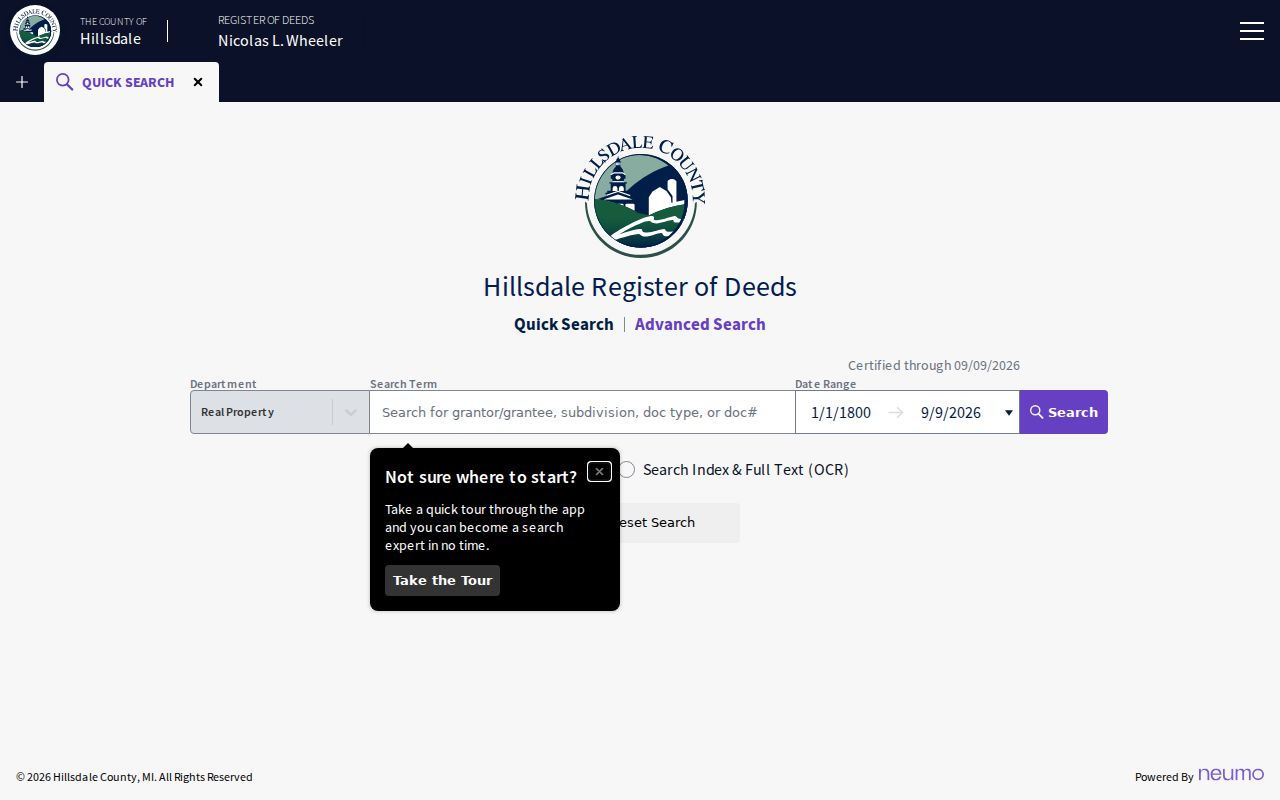
Set the date and scope controls with care. Then save the document number or liber/page from any promising result before you open or request the instrument.
Follow the Hillsdale County Grantor-Grantee Trail
Start the trail from a solid current reference. A parcel report often shows the last recorded deed. Find that instrument and read its receiving party as the grantee. The conveying party is the grantor, and that name becomes your next backward search.
- Locate the newest deed in which the present owner appears as grantee; confirm the parcel by legal description.
- Record the grantor, recording date, document number or liber/page, and exact legal description.
- Search that grantor as an earlier grantee, allowing for initials, name variants, trusts, estates, and entity names.
- Repeat until the digital trail stops, then carry the last known reference into tract books, deed books, or archival records.
- Grantor
- The party conveying the stated interest.
- Grantee
- The party receiving the stated interest.
- Chain of title
- The ordered sequence of recorded conveyances affecting the same land.
- Liber/page
- A volume-and-page reference used for legacy documents.
- Document number
- A unique modern recording reference that should be copied exactly.
Names alone cannot carry a chain. A person may have owned several parcels at once. Compare the legal description, subdivision, and recording sequence at every step. A spouse, fiduciary, successor trustee, or personal representative can step between familiar names without breaking the chain.
Document Numbers, Liber/Page, and OCR in Hillsdale
Liber/page and document numbers are two handles on one records history. The legacy system leans on liber/page. The cloud system favors document numbers. OCR adds full-text discovery across imaged pages, though recognition errors make it an aid rather than a complete index.
| Search clue | Best use | What to preserve |
|---|---|---|
| Party name | Grantor/grantee chain | Exact indexed spelling and role |
| Recorded date | Narrowing common names | Date range and sequence |
| Subdivision | Platted city or lake lots | Plat name, lot, and block |
| Liber/page | Legacy volume retrieval | Both numbers together |
| Document number | Modern instrument retrieval | Complete identifier |
When OCR comes up empty, switch to the index. Try name variants and a date or subdivision. If both web systems fail, give the Register the best known party, time span, and land description rather than repeating a broad query.
The Unposted Online Cutoff for Hillsdale Deeds
Local records descriptions trace Hillsdale County deed records back to 1835. That historical starting point does not mean every volume or image since then is online. The county page states no exact cutover for cloud indexes or images. Coverage has to be described source by source. A blanket online range would overstate what a visitor can pull.
Search the current indexed material first. Ask the Register whether the book you need is imaged. Tract books, physical deed books, the Archives of Michigan, and FamilySearch cover the older work. This distinction matters. An index reference can exist. The image itself may still require a counter or copy request.
Coverage check. Before reporting that a deed is missing, confirm the spelling, date range, cloud-versus-legacy system, tract-book reference, and image availability with the Register of Deeds.
Transfer Tax Clues Inside a Hillsdale Conveyance
Michigan transfer-tax figures can hint at a sale. County transfer tax runs $0.55 per $500. State transfer tax runs $3.75 per $500 where applicable. Always read the tax line against the deed and any claimed exemption. A family transfer, fiduciary transfer, or corrective filing often claims an exemption or nominal consideration. Those can look nothing like an ordinary sale.
Never convert a tax stamp into market value mechanically. The assessment roll, recorded consideration, transfer affidavit, and the circumstances of the conveyance each answer a different question. Consider the assessment roll. Recorded consideration and the transfer affidavit matter too. The circumstances of the conveyance answer another. For value interpretation, turn to the dedicated Hillsdale County property value guide.
Watch New Hillsdale County Deed Filings
Property Alert is a free Register service. It sends notifications based on a name or keyword, and one alert type can follow a selected recorded document. An alert may flag a lien, release, or unexpected ownership filing. It is a notification service only. It cannot guarantee that every fraudulent or mistaken filing gets detected.
Review the official Hillsdale Property Alert choices pictured below.
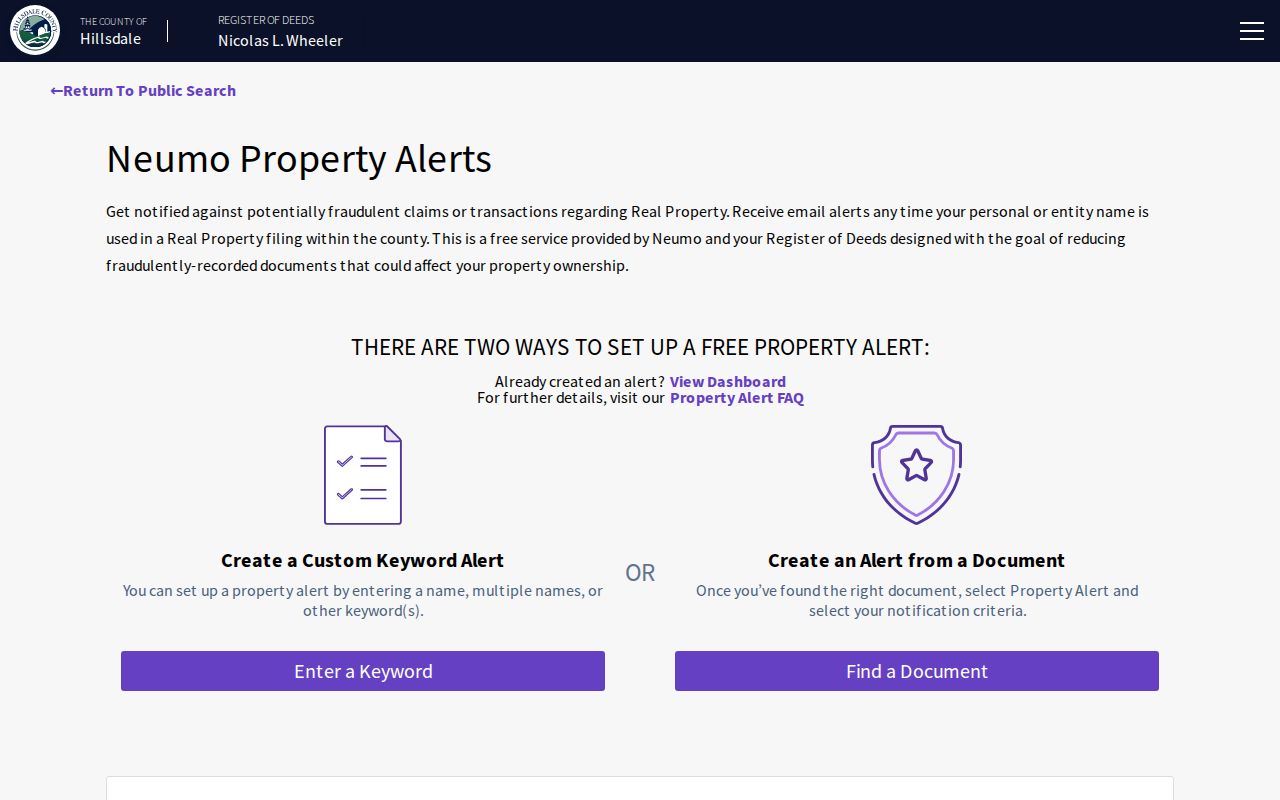
When an alert arrives, check its document number and date against the official index. Get the image or certified copy, and contact the Register promptly if the filing looks unauthorized.
When the 1847 Courthouse Fire Breaks the Deed Trail
Fire is the first hazard any deed researcher in Hillsdale County confronts. The first courthouse burned on December 28, 1847. County business moved into its replacement in January 1848. Nobody has produced a volume-by-volume account of what survived. So treat the fire as a reason to widen your property search. Do not treat it as proof that every early instrument is gone.
Surviving records still speak. Tax rolls can place a name on land between deeds. Probate files may explain how an estate passed to an heir. Census material, plats, newspapers, directories, and original land records can tie people to parcel descriptions when the deed trail thins. The Archives of Michigan county guide lists historic tax, probate, court, census, naturalization, and land holdings. These support exactly this kind of reconstruction.
A chain of title then becomes a documented argument rather than a guess. Cite each surviving record. State each gap plainly. And never let circumstantial occupancy evidence harden into an ownership claim. The property records cannot support that.
Request a Hillsdale County Deed Copy
Start with the online index. Record the party names, document type, recording date, document number or liber/page, and the legal description before you go further. If the image control does not deliver the deed you need, contact the Hillsdale County Register of Deeds at 29 N. Howell Street, Room 4, Hillsdale, or call 517-437-2231. Published office hours are Monday through Friday, 9 a.m. to 5 p.m.
The county publishes no dependable online image charge or certified-copy price for every instrument. So ask before sending payment. Have the Register confirm availability, delivery method, certification, and current cost in one conversation. The county GIS price schedule covers maps and assessment products only. It is not the deed-copy fee schedule.
Recorded, not guaranteed. Hillsdale County deed records show instruments accepted for recording; they do not resolve every unrecorded interest, indexing error, boundary conflict, or legal defect. A professional title examination is the appropriate route when clear title must be established.